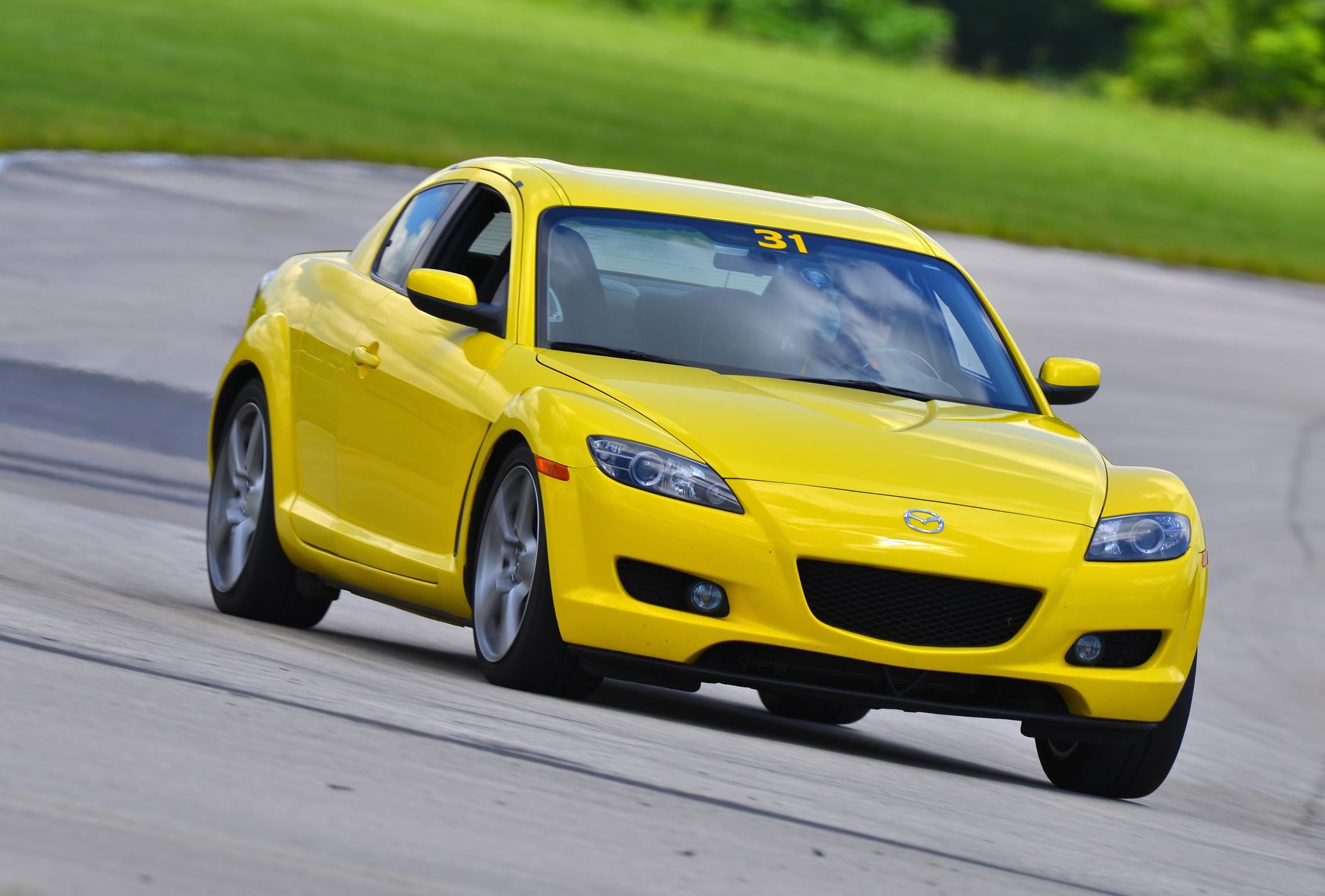
The Mazda RX-8 was never intended as a direct successor to the legendary RX-7, but it quickly gained similar popularity.
The ‘Wankel’ rotary engine continued to earn fans approval thanks to its uniquely smooth power delivery; the RX-8’s precise handling drew praise from the driving enthusiasts, and its unusual rear-hinged additional side doors were an appealing quirk. Those doors made it unusually practical for a sporty coupe, with easy access to a pair of surprisingly accommodating rear seats.
The interior was ergonomically designed and free of many of the flaws that would typically compromise comfort in a sports car. The RX-8 engine was a development of the much-loved Mazda 13B.
However, it was modified in so many ways it could almost be regarded as a different motor. It also had a different name - the Renesis rotary. Though the engine only displaced 1.3-litres, its mechanical efficiency was greater than normal piston engines.
To be technical though, the Renesis is a 654 cm3 x two rotor unit that generates 170kw maximum power of 170kw at 8,200rpm in Hi-Power guise, and was mated to a 6-speed manual gearbox. Despite being able to scream its way to its 9,000rpm redline; torque was in true rotary fashion laughable at 211nm.
This made it a sitting duck at the reef against lesser powered cars in the TLGP. At the coast, 0-100kph came up in a Honda S2000 rivalling 6.3 seconds and topped out at a claimed 235kph. In fact, in most track tests, the rear-wheel drive RX-8 frequently outperformed the S2000.
Interestingly enough, the twin-rotor Renesis engine was named “International Engine of the Year 2003”. The compact size of the engine went hand-in-hand with its low weight, which in turn made for terrifically agile handling. The cornering performance was delivered without Mazda needing to make the suspension too firm, so the ride was a lot smoother than many other coupes. The RX-8 still stands up against newer cars when it comes to driver involvement though.
In 2008, towards the end of the RX-8’s lifecycle in SA, Mazda Southern Africa sold it with a sticker price of R375 000. These days, expect to pay around R100K for one, but as withal rotaries, expect to rebuild the motor if you want to preserve it.
Also worth a look: the Mazda Gives the CX-3 a Tech and Style Boost for 2026 and the Mazda Cx 60.
FAQ
Q: What does the Mazda RX-8 cost in South Africa?
You can find a decent Mazda RX-8 from around R180,000 to R350,000 depending on condition, mileage, and year, with the cleanest examples pushing towards R400,000.
Q: Is the Mazda RX-8 worth buying?
The RX-8 is worth buying if you're prepared for higher maintenance costs and fuel consumption, but you'll get one of the smoothest-revving engines ever made and handling that rivals much more expensive sports cars.
Q: What are the common problems with the Mazda RX-8?
The biggest issues are apex seal failure if you don't warm the engine properly, heavy oil consumption (check levels regularly), and fuel consumption that'll make your wallet weep at around 12-15 litres per 100km.
Q: How reliable is the Mazda RX-8 rotary engine?
The Renesis rotary engine can be reliable if maintained religiously with proper warm-up procedures, regular oil changes, and quality fuel, but expect rebuilds every 150,000-200,000km depending on how it's driven.
Q: Should I buy a Mazda RX-8 as my first sports car?
The RX-8 makes a brilliant first sports car because of its forgiving handling and practical four doors, but budget an extra R20,000-30,000 annually for maintenance and fuel costs compared to conventional engines.
Should You Buy It?
The best rotary sports car under R400,000 in South Africa is absolutely the Mazda RX-8, and you should buy one if you understand what you're getting into. With 170kW from that screaming Renesis twin-rotor and handling that embarrasses cars costing twice as much, the RX-8 delivers driving thrills that'll make you grin every time you hit the redline. The rear-hinged doors and proper back seats mean you can actually use this thing daily without looking like a muppet climbing out of a two-door. Yes, it'll drink petrol like a thirsty elephant and yes, you'll need to baby that rotary engine with proper maintenance, but for R250,000-350,000, you're getting automotive soul that modern turbocharged boxes simply can't match. Buy the cleanest, best-maintained example you can afford and prepare for one of the most rewarding ownership experiences in the sports car world.